Having likely endured the pain and cruelty of having holes punched in his ears, having his tail cut off and being castrated without anesthetic, a sheep is torn away from his flock to begin a torturous journey. Hungry, scared, and without his family, he is sent abroad by the live-export industry and may endure weeks of suffering before his last moments, during which he will probably feel every slice of a dull blade cutting his throat.
Most Australian merino sheep are raised for their wool. They are subjected to rough shearing and "mulesing," a process in which huge chunks of flesh are cut from their backsides in a crude attempt to avoid "flystrike"—a parasitic infection of fly eggs that hatch in the folds of sheeps' skin—even though more humane prevention methods exist.
After enduring many rough shearings, when their worn-out bodies are no longer of use to the wool industry, these sheep are amongst the millions every year sent for live export. Australia exports more live sheep than any other country.
The main destination for sheep from Australia is the Middle East, and 99 percent of these gentle creatures go to destinations with few or no animal protection laws. Bahrain, Turkey, Qatar, Jordan, and Saudi Arabia are some of the major buyers of live Australian sheep.
Before the sheep are loaded onto the trucks that will take them to the ports, they are confined to feedlots for many days in an attempt to get them accustomed to the change of diet from the natural grass that they had consumed on paddocks for most of their lives to the processed, pulverized pellets that they will be fed aboard the ships. Salmonella can spread rapidly in feedlots, but because of the long incubation period, those who contract the bacteria usually do not exhibit symptoms, such as severe diarrhea, until they're already at sea.
During transport to and from the feedlots, sheep legally can be deprived of water for up to 38 hours. The animals are packed so tightly into trucks that they can barely move, much less turn around. Sheep called "downers"—those unable to walk off the trucks because of broken legs, crushed ribs, internal injuries, or disease—are very common.
Arriving at Australian ports, the terrified sheep are crammed by the thousands onto multitiered ships bound for the Middle East, Africa, and Asia. Up to 125,000 sheep can be transported on one ship alone, each packed into an area as small as 0.36 square meters (equivalent to just over two sheets of A4 paper) for the long journey. Travelling in searing heat, some animals can be smothered or even crushed to death in the struggle to get to the limited water and food supplies. Ships are also required to have a minimum of just one veterinarian on board, which makes it impossible for the sheep to be properly attended to and cared for.
In August 2011, the Al Messilah, a ship bound for Qatar, was forced to return to Adelaide because of mechanical failure. After 10 days in port, the sheep were finally unloaded, but more than 300 animals had starved to death because they could not become accustomed to the pellet food provided on board. More sheep died after the journey resumed.
Illnesses and injuries ravage the already distressed crowds of sheep aboard ships. Some of the more common afflictions include the following:
Starvation and salmonellosis are the two main causes of sheep deaths at sea, accounting for approximately 70 percent of all onboard mortalities. Other diseases that cause sheep to die aboard ships include muscular disease, lupinosis (a sometimes fatal disease caused by toxins produced from a fungus that causes weight loss and even death), foot abscesses, kidney stones, and dehydration.
Between 2000 and 2010, nearly a half-million sheep were reported to have died aboard live-export ships. Each one of these sheep had their own story of how they suffered and died.
Between October 2010 and October 2011, Australia exported more than 800,000 live cattle. Many of these animals were sent to countries with few or no animal protection laws. Indonesia received 57 percent of live-cattle exports from Australia, taking more than 460,000 animals in 2010 and 2011. Almost 74,000 cows were exported for use by the dairy industry and nearly 49,000 of them were sent to China.
Cattle are loaded onto the trucks that begin their long journey with the use of electric prods and dogs. Scared and confused, these social creatures are forced apart from their companions and crammed together to face a long and stressful road journey. During land transport, cattle can be deprived of water for as long as 48 hours.
At all stages prior to loading, Australian Standards for the Export of Livestock places the responsibility for enforcing animal welfare laws with the local state or territory. Yet the state governments themselves are unsure of their jurisdictions and responsibilities. As a result, cattle and other animals being prepared for live export receive little protection under these confusing guidelines.
When they finally arrive at the port, the animals are crammed onto ships carrying as many as 23,000 cattle. Australian standards for minimum pen restrictions allow exporters to provide just slightly more than one square meter for a 300-kilogram cow. The animals will be confined to this inadequate space for days or even weeks as they travel in the searing heat to destinations where they will face inhumane treatment and slaughter methods that would be illegal in Australia.
Cattle face many of the same illnesses and diseases as sheep on live-export ships, including pink eye, respiratory diseases, salmonellosis and heat stroke. The reportable death rate for cattle on live export ships is 1 percent, so on a ship carrying 23,000 animals, 229 might die—this would be considered an acceptable death rate.
Live-export ships are required to have only one veterinarian on board and carry very limited supplies of medication and proper euthanasia equipment. For 1,000 cattle, a ship might carry only 30 doses of anti-inflammatory drugs, 30 doses of antibiotics, and 40 cartridges for a captive-bolt gun. It should come as no surprise that agonizing injuries, diseases, and deaths are common on every journey.
Recently, following an investigation of Indonesian abattoirs that exposed appalling cruelty and inhumane slaughter, live export to that country was briefly suspended by the Australian government. Unfortunately, for the 800,000 cattle who suffer every year on these grueling journeys, this ban was lifted, even though there were no new laws put in place regarding the treatment of these animals on arrival at their destination, nor any further monitoring of the journeys.
Many animals arrive at their destination sick or injured but, even for the relatively healthy animals, all responsibility for their welfare and treatment is relinquished once they have been unloaded from the ship.
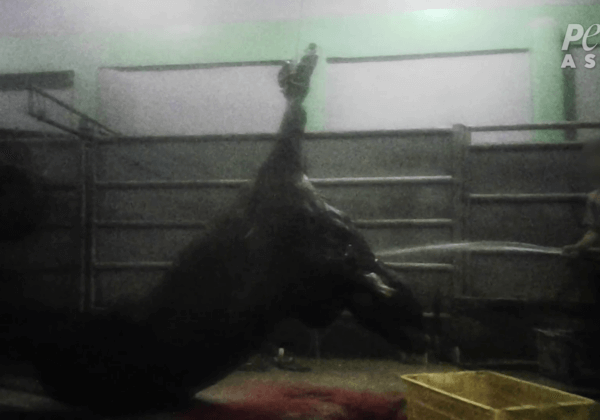
The surviving animals are often beaten and dragged off the ships by their legs before being thrown into the backs of cars or onto roof racks. Sheep are often taken to feed lots so that the sick and dying can be weeded out away from the public eye. Some sheep are slaughtered en masse in filthy lots, while others are taken home and killed individually by the purchasers. They are conscious as they are slaughtered with blunt knives.
There is no excuse for subjecting animals to these miseries. Muslim countries require that animals be slaughtered according to Halal regulations—which include saying a prayer to Allah and draining all blood from the animal's body—but there is no reason why these animals need to be slaughtered in countries without any animal welfare laws when Australia has numerous Halal-certified slaughterhouses.
Nor is live export financially beneficial to Australia. It actually harms the processing industry, pushing prices higher for the Australian consumer. Former Senator Andrew Bartlett wrote, "In addition to the intrinsic cruelty to animals involved in the live sheep and cattle trade, in my view there is clear evidence the trade directly costs jobs in Australia." Likewise, the RSPCA stated that the "live export trade costs jobs, because Australian livestock is sent overseas for slaughter when this work is desperately needed by abattoirs in rural and regional Australia."
Please write to the Australian Minister for Agriculture Joe Ludwig and ask him to support a ban on the barbaric live-export trade today.